Pain & movement
Back or neck pain, joint discomfort, and muscle tension can change your daily life. We discuss what hurts, how you move, and what you want to get back to doing.
Explore care for pain →
Blue Chrysalis Healthcare · Serving Southern Colorado

Eastern medicine. Integrative care. Whole-person health.
Acupuncture and Eastern herbal medicine serving people across Southern Colorado. Care begins with your concerns—pain, migraines, or other health challenges—and considers your daily life, current healthcare, and goals.
Call, text, or email · Appointments confirmed personally
Welcome to Blue Chrysalis
Pain, sleep, movement, nutrition, stress, relationships, and surroundings can influence one another. Whole-person health means considering these connections alongside your symptoms and what matters to you.
At Blue Chrysalis, care begins with listening. Dr. Jerry brings Eastern medicine training, rural clinical experience, and a research background to an individualized plan shaped by your priorities.
Meet Dr. Jerry →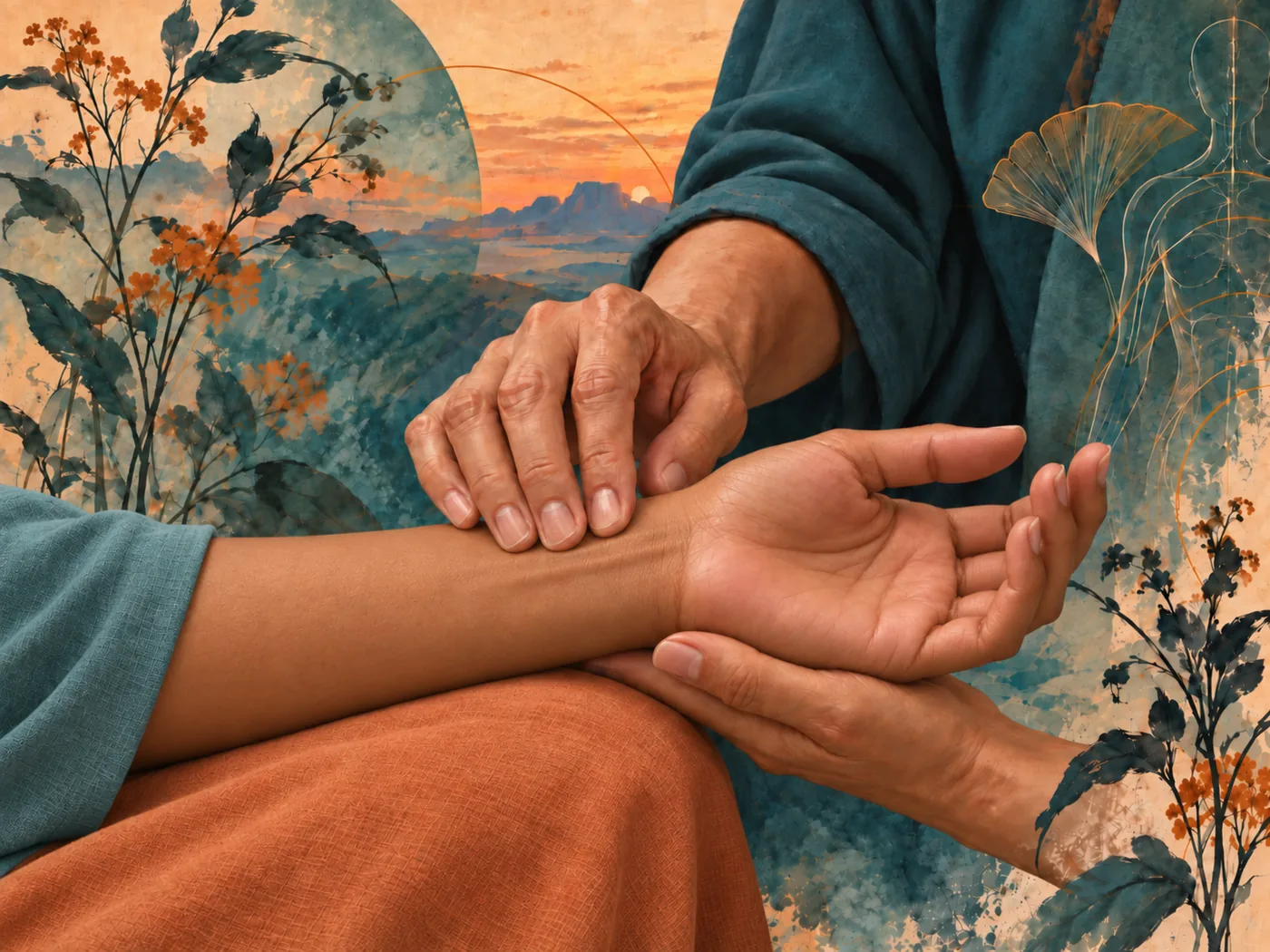
Back or neck pain, joint discomfort, and muscle tension can change your daily life. We discuss what hurts, how you move, and what you want to get back to doing.
Explore care for pain →Discuss your headache pattern, current treatment, and how symptoms affect your work, sleep, and everyday activities.
Discuss headache care →Bring other concerns, too. We consider sleep, stress, nutrition, and daily routines alongside your symptoms, with goals that matter to you.
How care begins →Research & learning
Begin with approachable introductions to whole-person health and acupuncture research, connecting Eastern medicine, Western biomedical understanding, and everyday questions.
Read at your own pace, bring questions to your visit, and explore the original sources. Video conversations and additional practical resources are planned as this collection grows.
Explore research & learning →Visit Blue Chrysalis
Call, text, or email Dr. Jerry to request an appointment. We’ll find a time together and confirm it directly.
417 University StreetTuesday–Thursday · 9 a.m.–5 p.m.
By appointment
For initial text or email inquiries, please share your contact information and preferred appointment times. Detailed medical information can be discussed through an appropriate clinical channel.
Meet Dr. Jerry
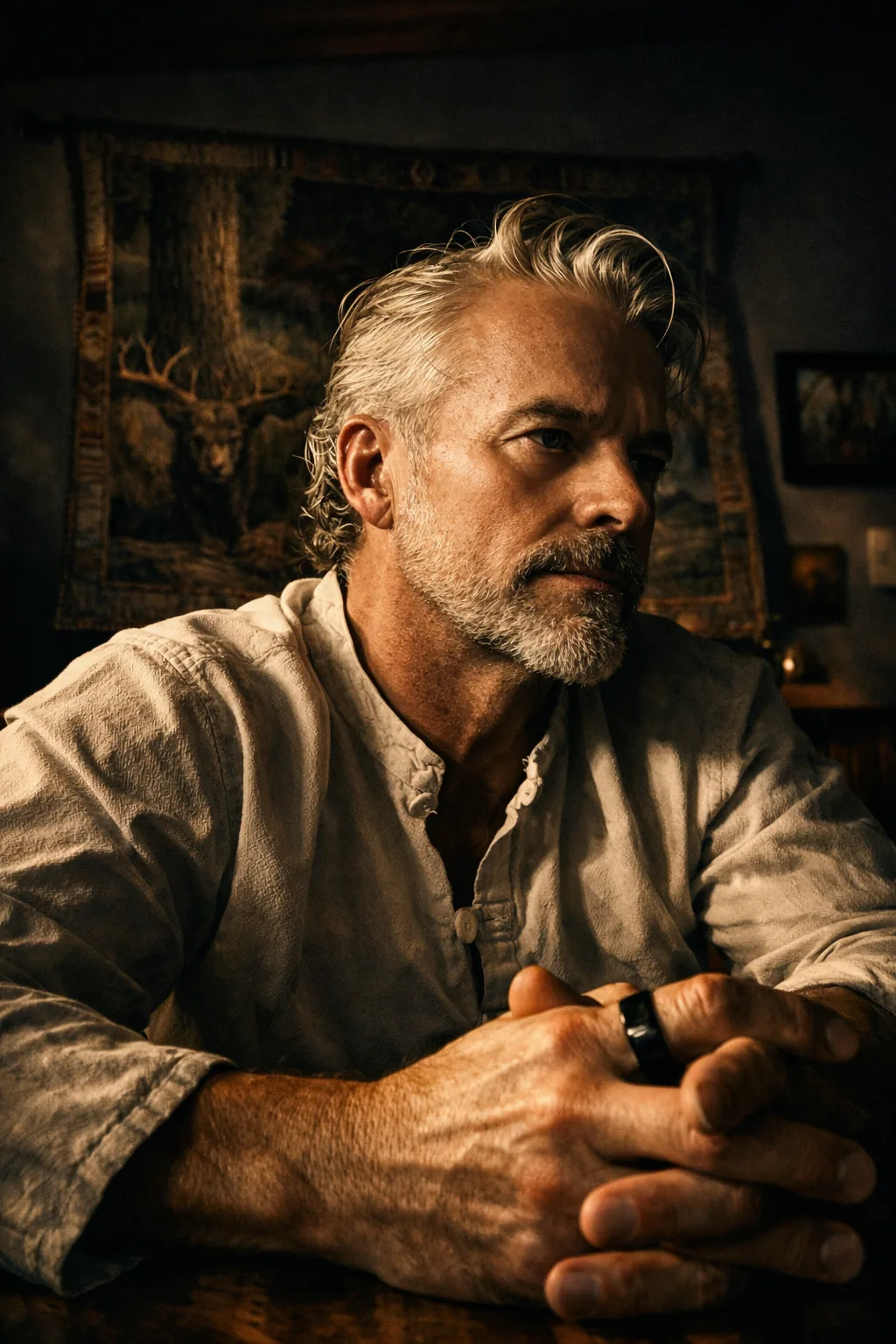
Clinician · Engineer · Researcher
I've spent much of my professional life asking how complex systems work. My first career was in electrical engineering and applied research. Today, that same curiosity informs my work with people.
After nearly three decades developing sensing technologies, conducting research, inventing systems, and leading multidisciplinary teams, I chose to study Eastern medicine. Its attention to relationships, patterns, timing, and individual context opened a new direction in my work without abandoning the analytical habits that shaped my first career.
I do not see engineering and medicine as two unrelated careers. Both ask how complex systems behave, how different parts influence one another, and how careful observation can guide useful action. As I sometimes say, I am doing much the same job—only now I am engineering with people rather than electronics.
My engineering background taught me to think in signals, feedback, competing hypotheses, mechanisms, and evidence. Eastern medicine offered another systems-oriented framework for understanding patterns and relationships in the human experience of health and illness.
I believe patients are better served when useful knowledge is not discarded simply because it arose from a different medical tradition. My aim is disciplined integration: respecting the strengths and limitations of Eastern medicine and conventional biomedicine while choosing approaches that fit the person, the clinical need, and the available evidence.
I keep the person—not a diagnosis, modality, or profession—at the center of care. I use evidence where it exists, speak honestly about uncertainty, preserve the depth of Eastern medicine, and coordinate with other clinicians when collaboration improves safety, clarity, or outcomes.
I founded Blue Chrysalis Healthcare in 2019. I now serve patients in Southern Colorado with acupuncture, electroacupuncture, Eastern herbal medicine, cupping, functional medicine approaches, pain and mobility care, whole-person care, and supportive integrative oncology.
Integrative oncology was a major focus of my doctorate and remains one of my strongest clinical and research interests. I am interested in how acupuncture, herbal medicine, symptom management, lifestyle support, and careful interdisciplinary coordination may help people during and after conventional cancer treatment. This work supports oncology care; it does not replace it.
My engineering career included NASA-funded graduate research, applied electromagnetics, radar and radio propagation, subsurface sensing and imaging, signal processing, federal research programs, technical leadership, scientific reporting, and multiple issued United States patents.
As a University of California San Diego REACH Scholar, I am beginning a two-year program in research methodology, study planning, scientific writing, collaboration, and the development of rigorous research in complementary and integrative health. I also contribute to research development at Colorado Chinese Medicine University through the NIH–NCCIH-supported REACH initiative.
My developing research interests include whole-person healthcare, integrative oncology and survivorship, chronic pain and neuropathy, electroacupuncture, Eastern herbal medicine, complex chronic illness, rural access to care, and practical methods for studying individualized treatment.
A chrysalis represents transformation. The clinic's name also honors my late son, Jedrek Kryztof Stolarczyk, whom I called “Blue.” Blue Chrysalis Healthcare carries forward both remembrance and the hope of helping people move toward meaningful change.
Clinical care
Many people come to the clinic for pain or migraines. Others bring a different concern—or several at once. We begin with your history, your priorities, and a conversation about where care may help.
Tell us where pain limits your day: turning your head, walking, working, sleeping, or enjoying a favorite activity. Your goals help guide the plan and how we assess progress.
We review the pattern and impact of your headaches alongside your medical history and current care. Follow-up can consider headache days, intensity, and disruption to daily life.
This is an adult general practice. You are welcome to ask about other concerns and whether Eastern medicine care, coordination, or referral would be appropriate.
Dr. Jerry uses fine needles, with most treatments focused on the arms and legs from the elbows and knees down. Depending on your needs, treatment may also include the ears, scalp, or abdomen. For pain concerns, he may treat around the painful area, such as the gluteal region for sciatica or around an affected joint. The proposed treatment areas are discussed with you before needling.
Individualized herbal care brings together Eastern medicine pattern assessment and biomedical understanding of herbal constituents—the compounds within herbs—and their studied actions.
Dr. Jerry draws on research into these constituents, including proposed mechanisms and potential herb–drug interactions, particularly in integrative oncology. Traditional reasoning and biomedical evidence inform formula selection, with attention to the strength and limits of the research, your medications, and other treatments. In cancer care, proposed herbal support is reviewed in coordination with your oncology team.
Controlled electrical stimulation applied through selected acupuncture needles when appropriate to the treatment plan.
A suction-based technique that may be included in your visit when appropriate. We discuss the approach and expected temporary skin marks before treatment.
An individualized approach that explores your health history, daily habits, and possible contributors to ongoing symptoms. We consider how concerns developed over time, along with your current healthcare, medications and supplements, nutrition, sleep, stress, and activity.
Together, we set priorities and plan realistic changes that fit your existing care and daily life. We revisit your response and discuss when further evaluation or coordination with another clinician would be useful.
Ask about functional medicine care →Integrative oncology
Integrative healthcare, with a particular emphasis on integrative oncology, was a major focus of Dr. Jerry’s doctorate. That training informs his interest in supportive care during cancer treatment and recovery.
Care begins with your priorities: symptoms affecting your day, sleep, comfort, nutrition, function, and quality of life. We discuss whether acupuncture or other appropriate supportive approaches may fit your situation, in coordination with your oncology team.
Supportive care complements your oncology treatment. Any proposed herbs or supplements require careful review with your cancer-care team because they can interact with treatment. The plan also takes account of treatment timing, blood counts, and other relevant precautions.
Discuss supportive oncology careExplore Dr. Jerry’s doctoral work →
Patient resource: NCCIH: Cancer and complementary health approaches
01 · Listen
We discuss your history, current care, daily routines, and the changes that matter most to you.
02 · Plan
We discuss suitable treatment options, expectations, and relevant precautions.
03 · Reassess
Together, we review symptoms, daily function, and progress toward your goals to decide whether care needs adjustment.

Research & learning
A growing space for clear explanations, thoughtful questions, and practical education. Understand what research says, what remains uncertain, and why it matters.
Whole-person health
A practical introduction to the connections between your symptoms, daily life, and goals.
Read the introduction →Research explained
What a research overview can tell us—and why your individual response still matters.
Read the introduction →Prepare for care
Know how to request an appointment, prepare for the conversation, and take part in your care plan.
Your first visit →A vision for collaborative healthcare
What if patients and clinicians from different traditions helped design a shared system of care together?
Dr. Jerry’s Third Sandbox concept explores patient-directed care, shared decision-making, and leadership that follows the clinical need. It is a proposed model for development and research.
Explore the Third SandboxSelected doctoral work · Colorado Chinese Medicine University · 2025
These papers and presentations were developed as part of Dr. Jerry’s doctoral research in integrative oncology, with a particular interest in diffuse large B-cell lymphoma (DLBCL). The summaries introduce the questions explored in his doctoral research; they are not peer-reviewed clinical trial reports or individual treatment recommendations.
Doctoral research · Literature review · October 17, 2025
How do lymphoma cells obtain energy, adapt to stress, and resist treatment? This paper examines metabolic reprogramming, cell-signaling pathways, and research on botanical compounds alongside conventional oncology approaches.
Source: “Metabolic Reprogramming in Non-Hodgkin Lymphoma (Focus on DLBCL),” developed as part of Dr. Jerry’s doctoral research.
The discussion connects metabolic and immune mechanisms with questions for integrative research. Laboratory findings about individual compounds do not establish that an herbal formula improves outcomes in people with lymphoma.
Doctoral presentation · Fall 2025
A presentation using a fictional teaching case to explore a proposed relationship between post-COVID immune changes, Epstein–Barr virus biology, and EBV-associated DLBCL.
Source: “When Viruses Meet Vulnerability: How Long COVID Can Enable EBV-Driven Diffuse Large B-Cell Lymphoma.”
The presentation develops a mechanistic hypothesis using a fictional teaching case. The person and clinical history are invented for educational discussion. It does not establish that Long COVID causes lymphoma or quantify an individual’s cancer risk.
Doctoral research · Pattern differentiation · December 6, 2025
An exploration of how Eastern medicine patterns can organize individualized clinical reasoning in the context of EBV-associated DLBCL, including mixed deficiency and excess presentations.
Original title: “TCM Pattern Differentiation and Treatment Strategies for EBV-Driven DLBCL.”
This doctoral research paper discusses pattern-based principles and proposed herbal strategies. Its comparisons between traditional patterns and biomedical processes are interpretive frameworks, rather than validated one-to-one biological equivalences.
Fictional teaching case · Doctoral presentation · December 16, 2025
A fictional teaching case examining R-CHOP chemotherapy alongside proposed individualized Eastern herbal care, treatment-related neuropathy, and changing supportive-care priorities during recovery.
Source: “EBV-Driven Diffuse Large B-Cell Lymphoma: A Case Report Integrating R-CHOP Chemotherapy with Targeted Chinese Herbal Medicine.”
The patient, treatment course, and outcomes in this teaching case are fictional. They illustrate clinical reasoning across treatment phases and are not observed patient outcomes or evidence of treatment effectiveness.
Portfolio summaries are adapted from the author’s doctoral research papers and presentations. Original document titles retain their original terminology.
As a UC San Diego REACH Scholar, Dr. Jerry is developing skills for turning questions from clinical practice into rigorous studies. His interests include individualized Eastern medicine, supportive oncology care, and whole-person health in rural communities. The REACH Center supports research training and collaboration across complementary and integrative health institutions.
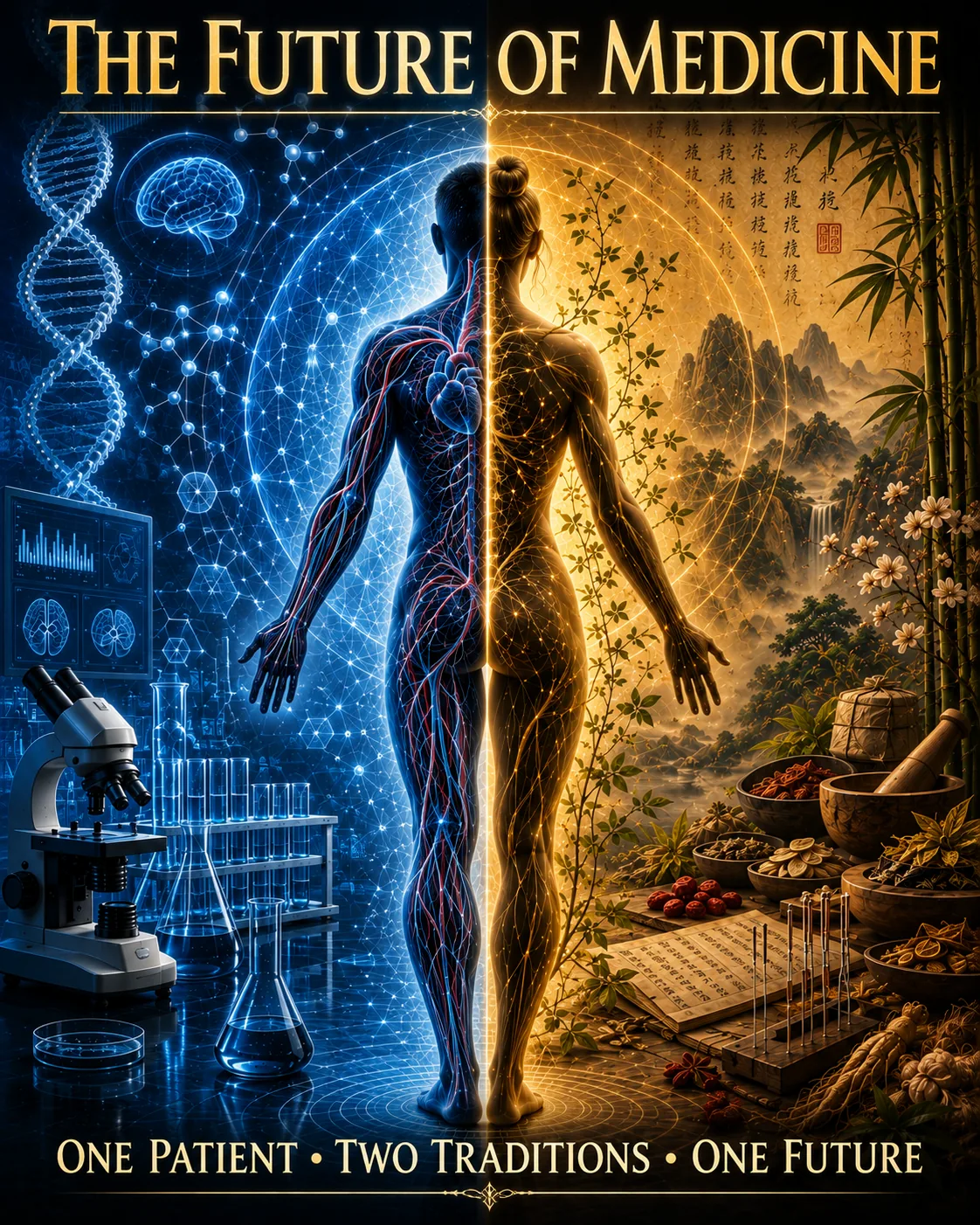
NCCIH: Understanding whole-person health →
UC San Diego REACH Center →
Coming later: video conversations with Dr. Jerry, recipes, and movement resources. New material will be added as it is developed and reviewed.
Visit Blue Chrysalis
Call, text, or email Dr. Jerry to request an appointment. We’ll find a time together and confirm it directly.
417 University StreetTuesday–Thursday · 9 a.m.–5 p.m.
By appointment
For initial text or email inquiries, please share your contact information and preferred appointment times. Detailed medical information can be discussed through an appropriate clinical channel.
Accessibility
Blue Chrysalis Healthcare aims to make its website usable by people with a wide range of abilities and assistive technologies.
We continue working to improve accessibility and use WCAG 2.2 Level AA as our accessibility target.
If you have difficulty using this website or accessing information, please contact Dr. Jerry by phone, text, or email so we can help.
Contact the clinicYour first visit
You do not need to have everything figured out before you reach out. Tell Dr. Jerry what brings you in and what you hope will change.
01 · Get in touch
Call, text, or email. Visits are scheduled personally, Tuesday through Thursday, 9 a.m.–5 p.m. Your appointment is confirmed directly with Dr. Jerry.
02 · Bring your story
Have a current list of medications, herbs, and supplements, along with relevant reports you would like to discuss. Think about when symptoms began and the activities they affect.
03 · Decide together
Discuss suitable options, your questions and preferences, and a way to assess progress. You can ask for an explanation or request a pause during treatment.
Use the call, text, or email links below. Include your contact information and preferred times. Appointment requests are confirmed personally; there is no self-booking calendar.
Wear loose-fitting, comfortable clothing with sleeves and pant legs that can easily roll above your elbows and knees. Most treatments focus on the areas from the elbows and knees down.
Please arrive well hydrated and avoid caffeine for several hours before your session.
Most treatments use points on the arms and legs from the elbows and knees down. Dr. Jerry sometimes also treats the ears, scalp, or abdomen. For pain, treatment may include the area around the discomfort—for example, the gluteal region for sciatica or around a painful joint. Any clothing adjustments needed for access will be discussed with attention to your comfort and privacy.
Appointments are scheduled for 75 minutes. Most visits finish in about 65 minutes; please allow the full appointment window.
The published treatment fee is $95 per session. Eastern herbal granules are charged separately at $0.50 per gram. A typical dispensing is 200 grams, costing $100; the amount dispensed depends on your individual prescription.
Blue Chrysalis is a self-pay practice and does not accept insurance. Payment may be made by cash, check, credit card, or HSA. Care decisions are guided by your clinical needs and goals, in partnership with Dr. Jerry.
Please give at least 24 hours’ notice to cancel or reschedule. If you arrive 10 minutes late or more, your appointment will be rescheduled. Missed appointments without notice (no-shows) are assessed a $75 fee.
Dr. Jerry uses fine acupuncture needles and finds that needling is rarely painful in his practice. Sensations vary from person to person. If you are nervous about needles, please let him know so you can talk through the approach together. Tell him if anything feels uncomfortable; you can ask for a pause or adjustment at any time.
We choose meaningful goals and revisit them. Examples include your pain level, headache days, sleep disruption, walking tolerance, or ability to do a particular daily activity. The plan can be adjusted as your response becomes clearer.
Bring information about your current healthcare and medications. We discuss how the proposed plan fits and when coordination with your other clinicians is appropriate. Herbs should be reviewed alongside medications and supplements.
The clinic is at 417 University Street, Trinidad, CO 81082. Contact Dr. Jerry for entrance and parking directions or to discuss mobility and access needs before arriving.
Whole-person health · Patient education
Your health has a context: your body, your daily routines, your relationships, and the places where you live and work.
NCCIH describes whole-person health as attention to connected biological, behavioral, social, and environmental influences. That perspective makes room for questions about sleep, movement, food, stress, and support alongside a particular symptom.
At Blue Chrysalis, the conversation might begin with back pain. It can also include the walk you miss taking, interrupted sleep, or the demands of your work. These details help turn a general wish to feel better into a meaningful goal.
You do not need a perfect journal or a complete explanation. Your observations give us a place to begin and something to return to as care progresses.
Source: NCCIH: Whole Person Health. Source consulted September 8, 2026.
Plan your first visitResearch explained · Patient education
Research can help guide a conversation about care. It cannot tell us in advance exactly how an individual will respond.
NCCIH’s overview reports that acupuncture may help some pain conditions, including back or neck pain and knee osteoarthritis. It also describes evidence that acupuncture may reduce migraine frequency. Findings differ by condition and by the treatments being compared.
A study comparing acupuncture with no treatment asks a different question from one comparing it with simulated acupuncture or another treatment. NCCIH notes that differences are often larger against no treatment than against simulated acupuncture. Context and the therapeutic relationship can also contribute to outcomes.
A useful care conversation considers both the research and your circumstances: current treatment, relevant precautions, preferences, and goals. Tracking symptoms and daily function helps guide reassessment.
Ask: What benefit are we aiming for? How will we measure it? When will we review whether this approach is helping?
Source: NCCIH: Acupuncture—Effectiveness and Safety. Source consulted September 8, 2026. This introduction summarizes an overview, not a new systematic review.
Discuss your questionsConcept development · Collaborative healthcare
A shared space for Eastern, Western, and complementary healthcare—with the patient helping shape the plan.
The “sandbox” is a metaphor for the rules, roles, and assumptions that organize healthcare. Dr. Jerry’s concept asks what would happen if clinicians and patients built a new shared environment together, instead of requiring everyone to work within a structure designed by a single discipline.
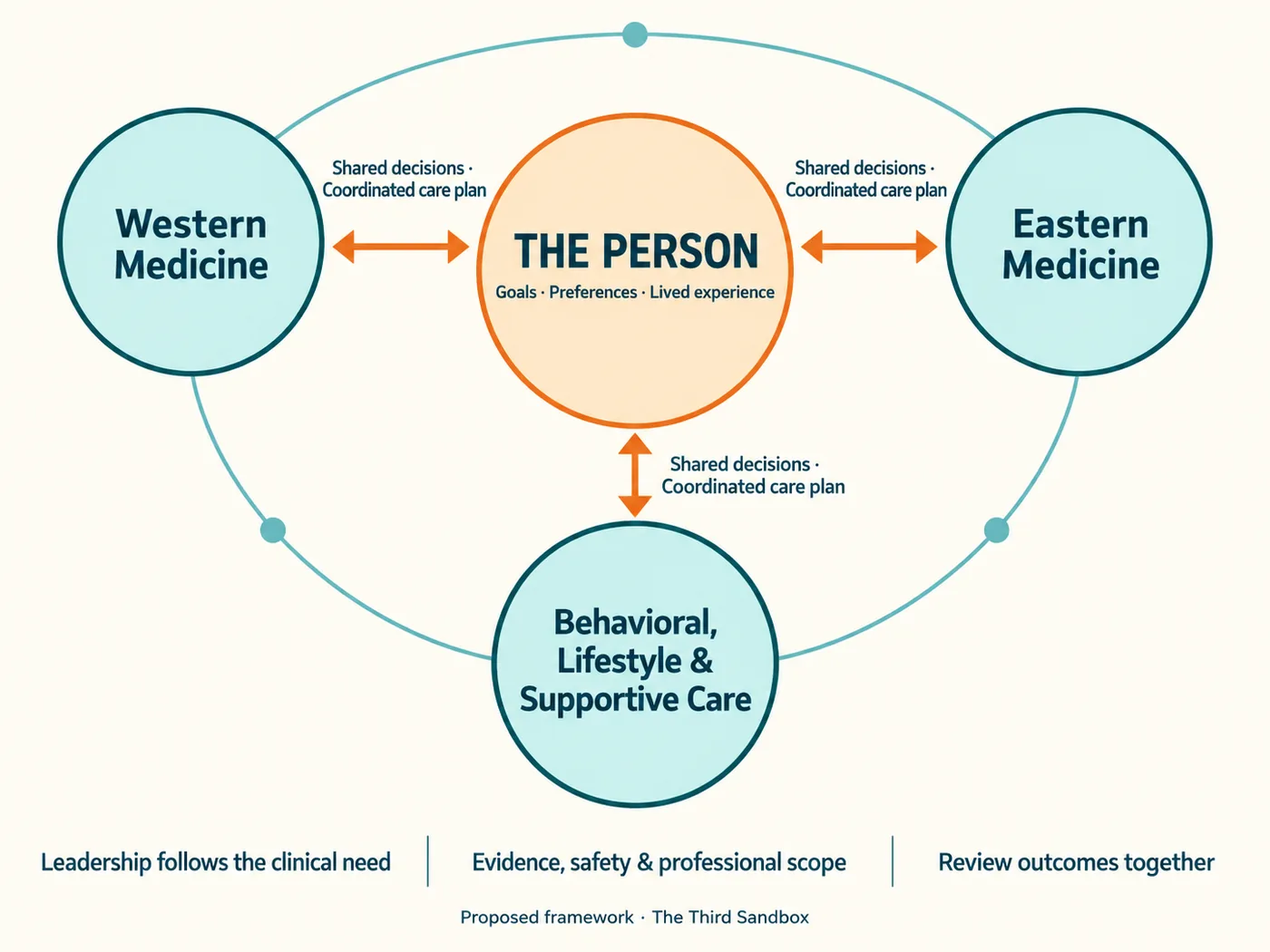
Collaboration would be built into how the team listens, makes decisions, shares responsibility, and reviews results. A coordinated plan would reflect the person’s priorities and the contributions most relevant to their needs.
The July 2026 research concept proposes an initial feasibility study of approximately 12–20 adults followed for 16–24 weeks. These are draft planning parameters. The first question would be whether this collaborative structure can be delivered consistently, safely, and acceptably.
The proposal would combine outcome measures with interviews about patient and clinician experience. Chronic musculoskeletal pain with related sleep or emotional concerns is suggested as a possible starting population. The design would explore early changes and practical challenges; it would not establish that the model is superior to other care.
The documents explore a rural nonprofit or public-benefit model, community participation, equitable access, and sustainable funding. This is a future design direction, separate from the current Blue Chrysalis practice.
The Third Sandbox is a proposed care and research framework. A multidisciplinary program, approved study, recruitment process, funding, and institutional partnerships are not being announced here.
This introduction summarizes the supplied concept documents. Research design, authorship, and participating organizations remain under development.
Discuss the concept with Dr. Jerry